
EVENT · 28 Apr 2026
REAL in Retrospect: What the Series Showed
Several events, more than 1,000 participants from 683 companies, and a shared understanding that the future of virtual assets is decided through dialogue.
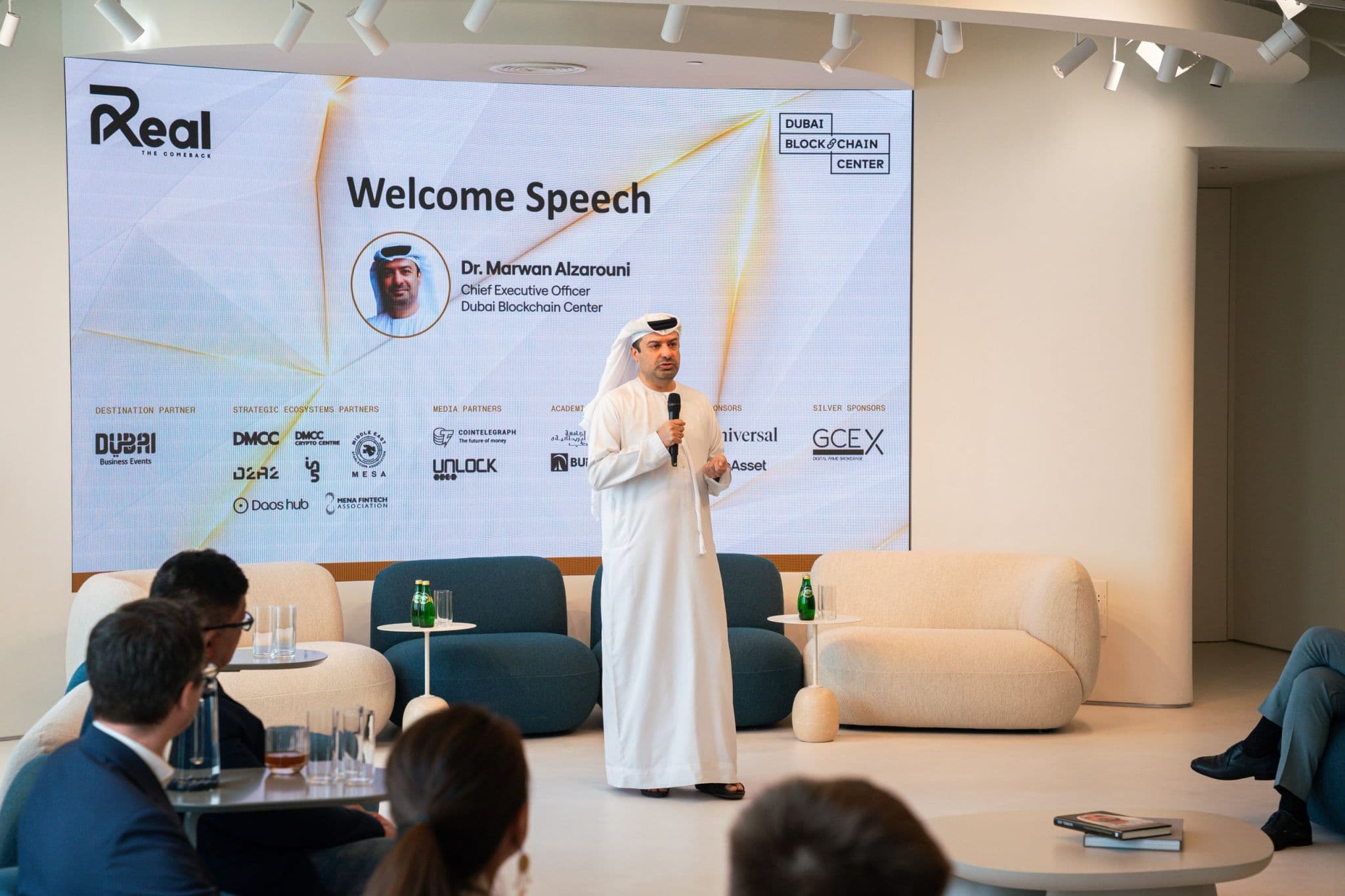
The UAE’s Digital Economy Strategy and the Dubai Economic Agenda D33 set a high bar: world-class digital infrastructure, faster innovation and a place for Dubai among the leading digital economies of the world. Goals of this scale depend on regulators, industry and academia working as one system rather than separately.
REAL, the institutional series held in Dubai by Dubai Blockchain Center, was created to make that cooperation happen in practice.
The idea behind REAL
The concept was straightforward. Invite the people who actually shape the sector, put them at the same table and give the conversation room to go where it needs to.
The core of the series was a set of closed-door roundtables. There were no audiences to perform for and no pressure to be seen. The value lay in candid discussion and in what participants could agree on together.
From Daos Hub to Dubai Police Academy
The roundtables ran in three rounds.
The first round took place at Daos Hub Dubai, in two closed-door sessions. Regulators and banks sat alongside exchanges, custodians, stablecoin issuers, family offices, infrastructure companies and academics. Three conclusions from these sessions shaped DBCC’s approach to the rest of the series: the sector moves forward when the public and private sides work together; the strongest ecosystems never stop asking what comes next; and because no one participant sees the whole picture, alignment has to be built jointly.
The second round was part of the REAL Summit at SO/ Hotel, Uptown Dubai, the series’ main event. The full-day programme combined closed-door roundtables on institutional digital infrastructure, regulatory alignment, institutional capital and market structure with keynotes, a series of panels and networking.
The third and final round, Closing Roundtable III, was hosted at Dubai Police Academy. It centred on two questions: how education must change for the new economy, and what tokenization means for the economy of the future. Around the table were the Virtual Assets Regulatory Authority (VARA), the UAE Ministry of Economy and Tourism, the Dubai Department of Economy and Tourism (DET), Dubai Police and Dubai Police Academy, together with universities, industry leaders, startups and international blockchain organisations.
The series in numbers
REAL welcomed more than 1,000 participants representing 683 companies. Senior officials, founders and directors made up over 63 percent of the audience.
The agenda was broad. Participants examined how blockchain is governed and funded, how financial infrastructure and regulation are evolving, and what identity, digital forensics, stablecoins, the tokenization of real-world assets and artificial intelligence mean for the digital economy.
The series received support from Dubai Business Events (DBE), part of the Dubai Department of Economy and Tourism.
The government perspective
Abdulaziz Al-Nuaimi, Assistant Undersecretary for Entrepreneurship and the Economic Affairs Regulatory Sector at the Ministry of Economy and Tourism, pointed to trust and legislation as the foundation for emerging technologies. In his view, building that framework serves the UAE’s target of having the digital economy contribute 19.4 percent of national GDP by 2032.
Ahmed Al Khaja, CEO of Dubai Festivals and Retail Establishment, part of DET, described REAL as evidence of how far Dubai’s blockchain and digital assets sector has grown and matured. He linked the series to the goals of D33 and to Dubai’s standing as a leader in innovation and the digital economy.
Built together
REAL was made possible by its partners and sponsors.
Government Partners: Ministry of Economy and Tourism (UAE), Dubai Department of Economy and Tourism, Dubai Police HQ, Dubai Police Academy
Regulatory Partner: Virtual Assets Regulatory Authority (VARA)
Strategic Ecosystem Partners: DMCC (Dubai Multi Commodities Centre), in5 Dubai, MENA Fintech Association, Middle East Stablecoin Association (MESA), Daos Hub Dubai, D2A2
Academic Partner: The British University in Dubai
Media Partners: Cointelegraph, Unlock Blockchain
Gold Sponsors: USDU / Universal, OneAsset, Crypto.com, CoinW, Ledger Enterprise, Aether VC, KARM Legal
Silver Sponsors: GCEX, BitDelta Group
Conclusion
The most valuable outcome of REAL was not a new technology. It was the proof that people from very different institutions can work towards a common goal when given the right setting.
Regulators came to listen. Academics questioned what others took for granted. Industry brought experience from the market, and innovators brought fresh ideas. Together they showed that responsible innovation depends on asking not only what can be done, but what should be done.
Technology will keep changing. What decides the shape of the digital economy is the people behind it. For Dubai Blockchain Center, REAL marks a starting point rather than a finish line.