NEWS · 19 Jun 2026
Joining the UNDP Blockchain Advisory Group
The UN’s new advisory body brings together 26 organisations from across the blockchain ecosystem to explore how the technology can serve public systems. DBCC is a founding member, and one of two UAE blockchain centers in the group.
Blockchain is no longer only a question for markets and developers. Governments and international institutions are now asking what it can do for public systems and for the people who rely on them.
The United Nations Development Programme (UNDP) already works on this question. Across Africa, Latin America and the Caribbean, the Middle East, Europe and Central Asia, and Asia-Pacific, it works with governments and ecosystem partners on applications ranging from digital payments and climate finance to digital identity, traceability, public procurement and public service delivery.
In June 2026, during Proof of Talk 2026 in Paris, UNDP launched the Blockchain Advisory Group to bring the blockchain ecosystem directly into this work and move from dialogue to concrete collaboration.
Alongside the launch, UNDP AltFinLab, the organisation’s flagship initiative at the intersection of innovation, finance and emerging technologies, held a series of events under the banner Scaling Blockchain for Public Good. The program included the SDG Blockchain Accelerator Impact Showcase and a public dialogue with the Sciences Po Tech & Global Affairs Innovation Hub.
Inside the first meeting
Dr Maria Papadaki, Chief Operating Officer of DBCC, represented the Center at the inaugural meeting, chaired by UNDP Associate Administrator Haoliang Xu.
The session opened with one of the most difficult questions in development: how to bring more people into the financial system. Members discussed the barriers that limit access to financial services, from fragmented payment systems and digital identity constraints to interoperability, compliance and institutional readiness. They looked at how blockchain can complement existing infrastructure to expand access, improve efficiency and strengthen transparency.
For UNDP, the aim is practical. The question is not how fast blockchain evolves, but where it can deliver real public value and better outcomes for people and planet. The Advisory Group gives development actors and the blockchain ecosystem a shared space to answer that question together.
Blockchain adoption in practice
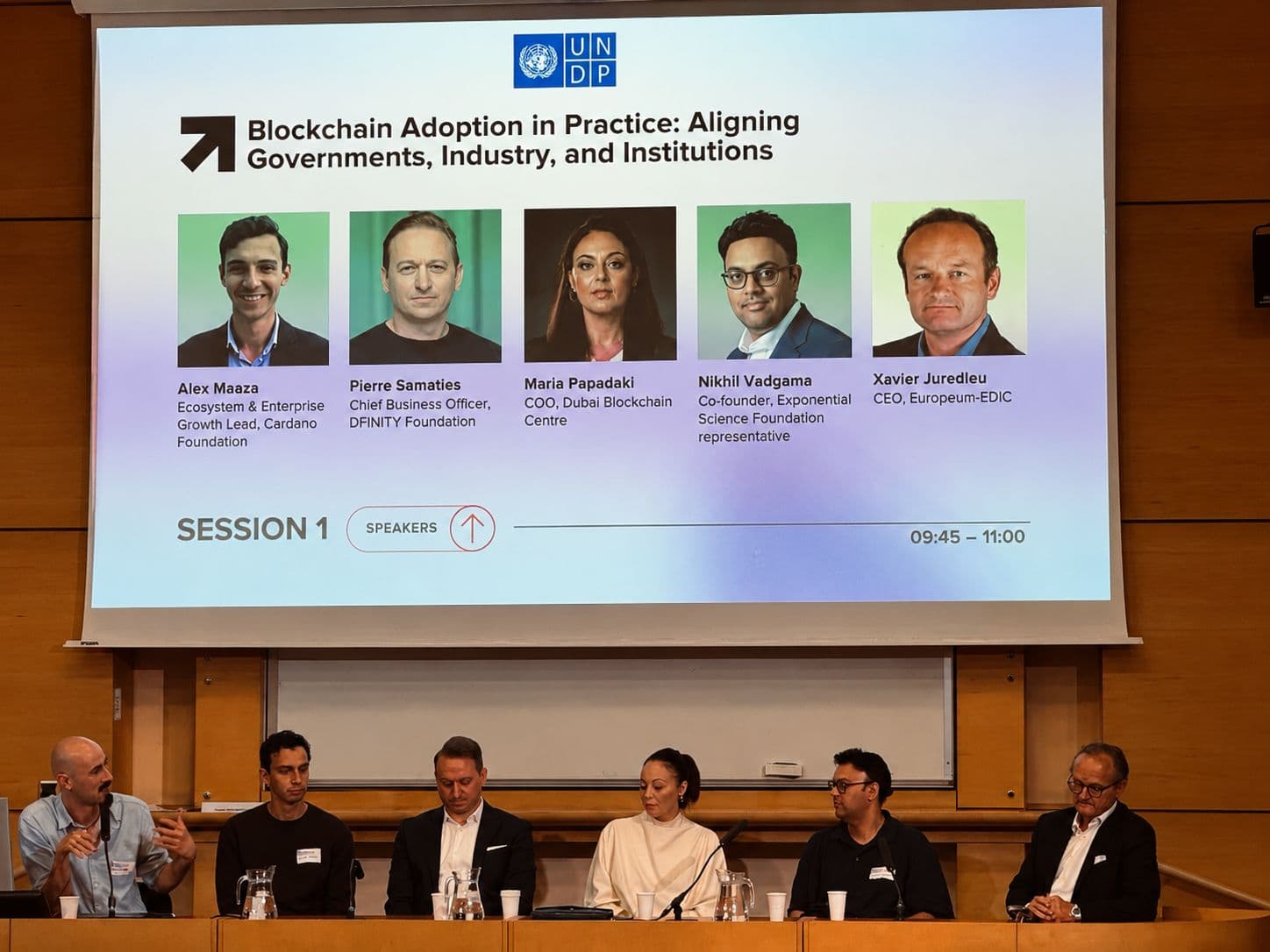
Dr Papadaki also spoke on the UNDP panel “Blockchain Adoption in Practice: Aligning Governments, Industry, and Institutions”.
She was joined by Alex Maaza, Ecosystem & Enterprise Growth Lead at the Cardano Foundation; Pierre Samaties, Chief Business Officer of the DFINITY Foundation; Nikhil Vadgama, Co-founder, representing the Exponential Science Foundation; and Xavier Juredieu, CEO of Europeum-EDIC.
Reflections from Paris
Dr Papadaki had expected the discussions to centre on blockchain, artificial intelligence, digital infrastructure and emerging technologies, and they did. What stayed with her was something else.
“But what genuinely surprised me was that, no matter where the conversation started, it almost always came back to people. People shape technology. People govern it. People decide how it is used. And people will ultimately determine whether it serves society or not,”
The discussions left her with a new idea: that the next disruptive role in the new economy may not be another AI engineer, but an Organizational Philosopher, or a Chief of Noesis, responsible for bringing truth, understanding and sound judgment into how organisations make decisions.
A seat at the table
Dubai Blockchain Center is proud to help shape this work from its start. DBCC sits alongside the Ethereum Foundation, Stellar Development Foundation, Cardano Foundation, Web3 Foundation and other organisations that have defined the blockchain industry. This is recognition of what Dubai has built since the Center opened in 2018, and a responsibility.
The UAE chose to write the rules of blockchain rather than inherit them. A founding seat in a UN advisory group is what that choice looks like on the global stage.
It also reflects what DBCC stands for. We believe the next generation of digital infrastructure must be built around people: technology should not only improve systems, but strengthen human connectivity, expand opportunity and elevate human intelligence. For a center whose work begins with education, that is where everything starts.
The road ahead
The Advisory Group will meet twice a year, each time around one theme, with the goal of turning discussion into concrete opportunities for collaboration.
Financial inclusion was the first. The group’s other priority areas include:
- public trust and digital governance
- inclusive society and legal identity
- sustainability, climate and trackable responsibility
- digital labour and the future of work
As blockchain becomes a foundational layer of the global digital economy, DBCC looks forward to contributing its expertise to trusted, inclusive and interoperable digital ecosystems, together with UNDP AltFinLab and fellow members of the group.
Conclusion
Paris marked a beginning. For the United Nations, it opened a structured dialogue with the blockchain industry on how the technology can serve the public. For Dubai Blockchain Center, it was a chance to bring Dubai’s experience into that dialogue from the very first meeting.
The true measure of this work will be practical: public systems that function better, and wider access for the people who depend on them. That is the standard DBCC will hold itself to as the group’s work continues.