ECOSYSTEM · 30 Apr 2026
From Dubai to Semarang: Building a Blockchain Ecosystem
A new chapter of the Indonesia Blockchain Center, based at Universitas Dian Nuswantoro and affiliated with Dubai Blockchain Center, brings together partners from Indonesia, the UAE and Malaysia to grow blockchain expertise in Central Java.
Technology alone does not create adoption. A country or a region needs institutions to host the work, specialists to carry it out, partners to supply the tools and a framework that holds it all together. Without these, even the best technology stays a pilot.
Building that foundation is at the core of what Dubai Blockchain Center does, and increasingly it does so beyond the UAE. Semarang, in Indonesia’s province of Central Java, is one of the clearest examples.
A new blockchain centre for Central Java
Universitas Dian Nuswantoro (UDINUS) in Semarang is now home to a chapter of the Indonesia Blockchain Center (IBC), opened jointly by the IBC, Dubai Blockchain Center and Sealbound UAE. Housed in the university’s Faculty of Computer Science, it is the first place in Central Java dedicated to the study and development of blockchain, and it works in direct affiliation with DBCC.
The IBC sees the chapter as part of a wider national effort, with UDINUS setting an example for others.
“UDINUS will become a national role model in using blockchain for education, certification and anti-fraud systems,”
The partners behind it
The chapter is the result of several institutions working towards one goal, each bringing something different.
UDINUS hosts the centre and connects it to students, faculty and the wider academic community of the region. The Indonesia Blockchain Center brings national reach and its role in shaping Indonesia’s blockchain ecosystem. Sealbound UAE, built by the Top Netics team, provides the technology for verifiable credentials. NEXSTOX Malaysia is also part of the collaboration.
Dubai Blockchain Center connects these partners to an international framework. Through affiliation with DBCC, the chapter gains a benchmark drawn from Dubai’s experience of putting blockchain into practice, and the credibility of a government-backed center.
Building local talent
An ecosystem lasts only if it can grow its own people. A university is where that growth begins: students who study blockchain today become the developers, researchers and decision-makers the region will need tomorrow.
UDINUS sees the chapter as a way to raise that talent to international standards.
“Through this global collaboration, UDINUS is ready to become a centre for blockchain development and for training digital talent to international standards,”
First result: blockchain-verified diplomas
The collaboration soon produced its first practical result. UDINUS set itself a target no Indonesian university had reached before: every graduate would receive a diploma recorded on blockchain. A diploma issued this way cannot be altered, and employers or other universities anywhere can confirm it without chasing paperwork.
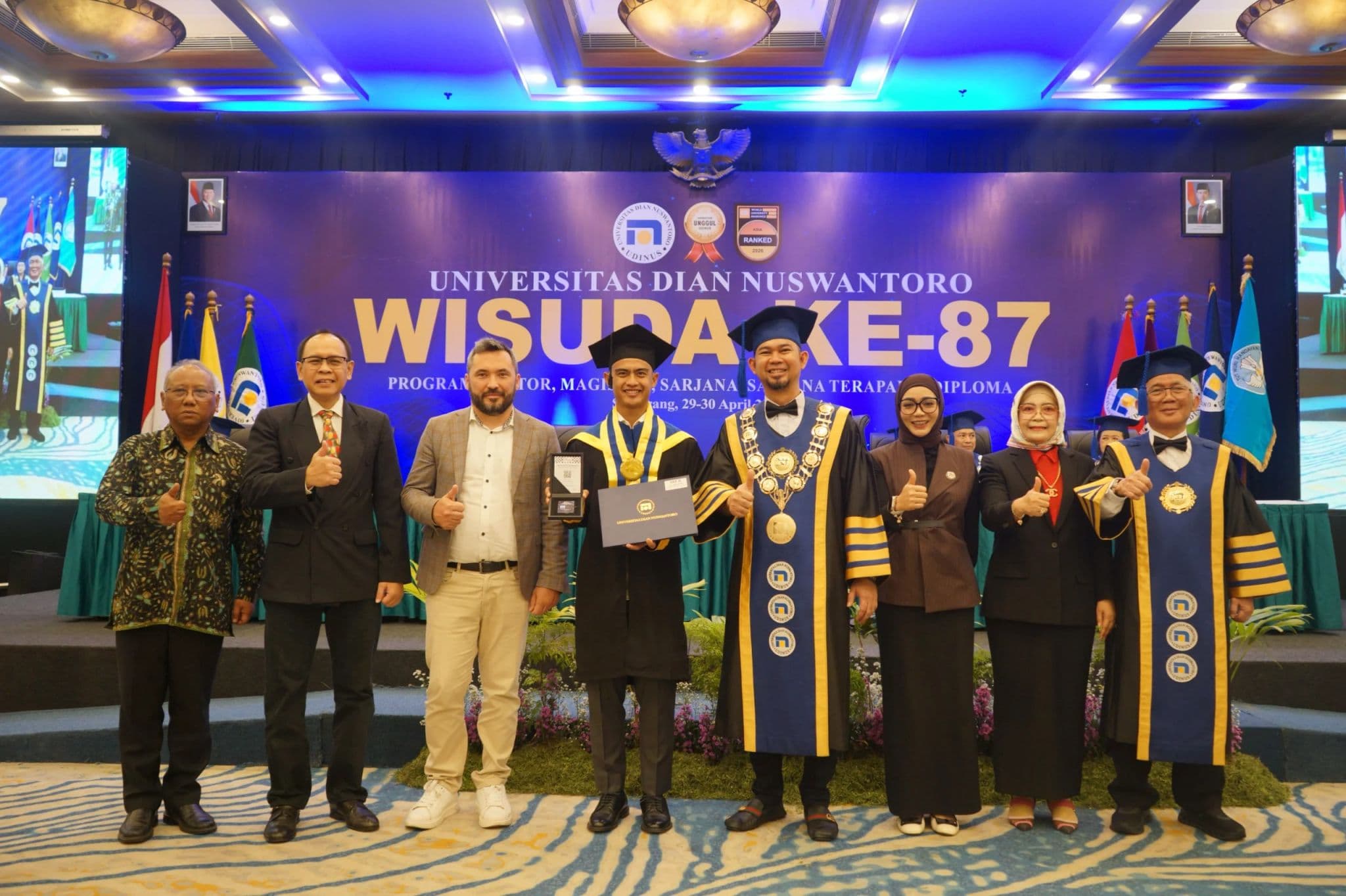
The university has delivered on that commitment. More than 2,000 blockchain-verified diplomas, powered by Sealbound, have been issued to date. Each is recorded on-chain and can be checked with a single QR scan. Among the graduates who received the new diplomas was Pratama Arhan, a member of Indonesia’s national football team.
Ihor Arkhypenko, Chief Innovation Officer at Dubai Blockchain Center and Co-Founder and CEO of Top Netics, attended the graduation ceremony. The milestone was covered by Tribun News, Radio Republik Indonesia and Berita Jateng.
DBCC’s role
In Semarang, DBCC’s contribution was not a product but a structure. It reflects three areas at the core of the center’s work: education and talent, through a university chapter focused on training specialists; advisory and standards, through affiliation and a framework to follow; and ecosystem building, through bringing academic, national and technology partners together around one goal.
This is how the UAE’s experience travels. The UAE chose to write the rules of blockchain rather than inherit them. Sharing what that choice has taught is part of how DBCC helps other regions build their own.
Conclusion
A blockchain ecosystem is not launched in a day. It grows from institutions that commit, people who are trained and partners who stay.
Semarang now has all three, and its first graduates already carry the result with them. For Dubai Blockchain Center, this is what guidance looks like in practice: helping others build something that will keep growing long after the launch.